Science kit · Grades 5–8
Restore a damaged meadow
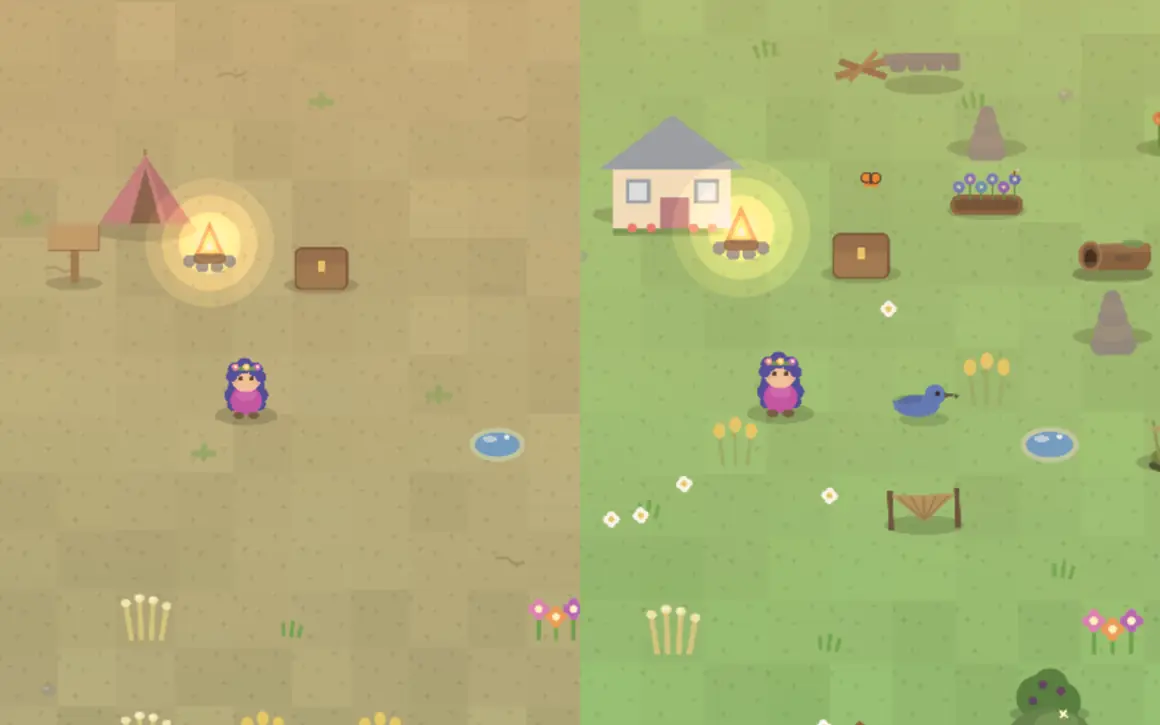
Students rebuild a stripped grassland in Wild Willows, watch real wildlife move back in on its own, and work out why each animal came back when it did. One class period, free to run, nothing to sign up for.
You do not need to play games to teach this
There is no score, no timer, no combat and no way to lose, so nobody has to be good at anything for the lesson to work. Students gather seeds and stones, plant grass and wildflowers, dig a pond, and animals arrive on their own once the meadow can actually meet their needs. Ten minutes with it yourself is enough preparation to run the room.
The learning is not in the game. It is in the gap between what students predicted on Worksheet 1 and what actually happened, and that discussion is the part worth protecting when the period runs short.
This is the science kit. There is also a computer science kit for grades 9–12, where students pull real Wild Willows data into a webpage they build themselves. Both kits.
What students can do by the end
- Name the four things a habitat has to provide, and explain why providing three of them does nothing
- Predict which animal returns next, and support it with what the meadow now has
- Explain why two species in the same meadow need different things from it
- Describe the order biodiversity returns in, and why the hunters arrive last
- Use a food web to explain why one species depends on another being there first
- Record a change and its effect as paired evidence, rather than as a list of animal names
- Change one thing at a time, and say what that lets them conclude
- Count biodiversity before and after, and argue about which number moved most
- Name three things this model gets right about nature and three it leaves out
- Explain why a model is still useful when it is not complete
The ordering objective is the one that separates this from a habitat worksheet. Most students can list what an animal needs; far fewer can explain why the hawk cannot arrive until the voles have.
Standards this supports
Every code below was checked against the published standard, and each row says where in the kit it actually happens.
The activity is built to be evidence-based rather than answer-based, so what students hand in is a record of what they tried and what happened. Pair it with your own state or district framework; most are NGSS-derived, and the performance expectations below are the common ancestor.
NGSS — Ecosystems: Interactions, Energy, and Dynamics
Middle school, grades 6–8. These three are the spine of the lesson. NGSS puts the ecosystems performance expectations at 6–8, so a grade-5 class is teaching toward them rather than against a code of its own — turn on Simpler wording and lean on Worksheets 1–3.
| Code | What it asks for | Where the kit does it |
|---|---|---|
| MS‑LS2‑1 | Read data as evidence for how the resources available in an ecosystem affect the organisms and populations living in it. | Worksheet 2, Field Log. Fourteen rows pairing each thing built with the arrival that followed it and the meadow health reading at the time. The arrival ladder is resource availability driving population, stated as a table. |
| MS‑LS2‑2 | Explain and predict the patterns of interaction between organisms, and have the explanation hold across more than one ecosystem. | The closing discussion: ten groups built ten different meadows, so why did roughly the same animals arrive first in all of them? Worksheet 5 carries it across ecosystems — students predict first and last arrivals in a habitat they invented, and the same ordering has to hold there. A second biome does the same job if you have the time. |
| MS‑LS2‑4 | Argue from empirical evidence that changing part of an ecosystem changes its populations. | The strongest fit in the kit. Worksheet 4, Habitat Detective: pick a species that never showed up, diagnose what it lacks, change one thing, check. The one-change-at-a-time rule is what makes the resulting claim an argument rather than a guess, and Worksheet 3 closes it by asking which biodiversity number moved most, and why. |
NGSS — Engineering Design
Middle school. Restoration is a design problem, and Worksheets 4 and 5 run it as one.
| Code | What it asks for | Where the kit does it |
|---|---|---|
| MS‑ETS1‑1 | State the criteria and constraints of a design problem precisely enough that a solution can succeed or fail against them. | Worksheet 4’s diagnosis step: naming exactly what a missing species lacks turns “the fox is broken” into a specification. Worksheet 5 asks for a damaged habitat and a restoration plan in which every species has a stated reason to live there. |
| MS‑ETS1‑2 | Evaluate competing solutions with a systematic process against the criteria and constraints. | The two trading activities. Groups swap machines and work out, from the meadow alone, what the previous group built and in what order; or groups trade Worksheet 5 plans and hunt for a species whose needs are not actually met. |
| MS‑ETS1‑3 | Compare test data across several solutions and combine the best of each into a better one. | Pooling every group’s field log into one class dataset on the board. Ten meadows, ten build orders, one question about which sequence got furthest — and what a group would do differently with the class’s data in hand. |
The dimensions this lesson actually exercises
Three-dimensional teaching is the point of NGSS, and the practices and crosscutting concepts travel further than the individual codes do. These are the ones the kit puts real weight on.
Science and engineering practices
Crosscutting concepts
Worksheet 6 is the nature-of-science one. Sorting what the game gets right from what it leaves out, then arguing whether an incomplete model is still useful, is not a performance expectation — it is the understanding about the nature of science that sits underneath all of them. It is also the part that transfers to every other model your students will meet.
Where the kit does not reach
Worth knowing before you write it into a unit plan, and worth saying because the omissions are the same ones Worksheet 6 asks students to find.
- Nothing dies, competes or goes hungry. Any performance expectation resting on competition, predation as loss, or population decline is not covered here.
- No invasive species, pollution or disease. Human impact appears only as the damage that happened before the lesson starts.
- No quantitative energy or matter. Trophic structure is shown; the accounting is not.
- Restoration takes minutes. Timescale is the model’s biggest simplification, and students should name it.
Standards text. The middle column above is a plain-language description of each performance expectation, written for this page — not the official wording. Follow any code to read it in full on the NGSS site. Citation: NGSS Lead States. 2013. Next Generation Science Standards: For States, By States. Washington, DC: The National Academies Press. Neither WestEd nor the lead states and partners that developed the Next Generation Science Standards were involved in the production of this product, and do not endorse it.
Vocabulary
One line each. Copy this onto the board, or print the page. The game itself uses the plainer word in each pair when Simpler wording is on.
Before the Lesson
- Open Willow Meadow once yourself. Ten minutes. Plant a grass patch, wait for it to finish growing, and watch the grasshopper arrive. You will have seen the entire mechanic the lesson rests on.
- Decide demo or installed copies. The free browser demo needs nothing installed and no sign-in, which is what makes it work on locked-down school machines; its saves do not reliably survive to the next period. Installed copies save locally and run fully offline. Either runs the whole lesson.
- Check the network can reach
play.wildwillows.app. Do this a week ahead rather than the morning of, if you are using the demo. A filtered domain needs an IT ticket, not a fix you can make in the room. - Turn on Settings › Simpler wording. It rewords the whole game, animal notes included, in shorter everyday sentences. Nothing is hidden; it is said more plainly, and it makes the field journal far easier at this age.
- Print Worksheets 1–3. One per student, or one per pair.
- Optional. Set Language to Español, and check Text size and Colorblind mode for students who need them.
Fifteen minutes of prep, honestly. There are no accounts to create, no class codes to hand out and no rosters to upload.
Worth saying out loud on day one: there is no score in this game and no way to fail. Groups that fill every tile are not doing better than groups that built carefully and watched closely. Telling students that up front changes what they pay attention to.
Three ways to run it
One period, 45–60 minutes
The timings are a guide. The discussion at the end matters more than finishing the play block, so take the time out of the middle rather than off the end.
Two periods
A good day-two variation: groups swap machines and try to work out, from the meadow alone, what the previous group built and in what order.
One projector, no student machines
Grouping
- Works best. One drives, one records.
- Swap at the halfway mark, so both students have driven and both have had to write down a reason.
- Good when machines are limited.
- Give each student a role: gatherer, recorder, observer.
However you group them, students create and name their own caretaker when the game starts. It takes a minute or two, and it is worth letting them have it.
The arrival ladder
Meadow health rises as students plant and build, and every species has its own threshold. This is the ladder they are climbing, and it is the answer key to most of what happens in the room: when a group asks why the fox will not come, the answer is in this table.
All twenty-five Willow Meadow species, in the order they can arrive. “Waiting on” means that species has to be living in the meadow already.
| Species | Group | Health | What it needs built | Waiting on |
|---|---|---|---|---|
| Grasshopper | Plant-eater | 8% | Grass Patch | — |
| Pillbug | Recycler | 9% | Crumbling Log | — |
| Prairie Vole | Plant-eater | 10% | Grass Runways | — |
| Snail | Recycler | 10% | Damp Leaf Corner | — |
| Ladybug | Insect-eater | 12% | Clover Patch | — |
| Ground Squirrel | Omnivore | 14% | Burrow Town, Dry Stone Wall | Grasshopper |
| Monarch Butterfly | Plant-eater | 15% | Milkweed Bed, Pollinator Garden | — |
| Song Sparrow | Omnivore | 16% | Hidden Grass Nest, Berry Bush | Grasshopper |
| Garter Snake | Mid-predator | 20% | Meadow Winter Den, Dry Stone Wall | Grasshopper, Prairie Vole |
| Praying Mantis | Insect-eater | 24% | Egg-Case Stem, Wildflower Patch, Native Grass Patch | Grasshopper, Monarch Butterfly |
| Bumblebee | Plant-eater | 25% | Nesting Tussock, Native Thistle Stand | — |
| Cottontail Rabbit | Plant-eater | 25% | Brush Hollow, Berry Bush | — |
| Garden Spider | Insect-eater | 26% | Web Anchor Stems, Wildflower Patch | Grasshopper, Ladybug |
| Groundhog | Plant-eater | 38% | Meadow Burrow Mound, Native Grass Patch, Brush Pile | — |
| Opossum | Omnivore | 44% | Den Hollow, Hollow Log | Grasshopper, Snail |
| American Goldfinch | Plant-eater | 45% | Sunflower Patch, Native Thistle Stand, Native Grass Patch | — |
| Western Meadowlark | Omnivore | 45% | Domed Grass Nest, Native Grass Patch ×3, Bird Perch | Grasshopper, Praying Mantis |
| Brown Bat | Insect-eater | 50% | Maternity Roost, Small Pond, Oak Tree | Praying Mantis |
| Bluebird | Insect-eater | 55% | Bluebird Nest Box, Berry Bush, Bird Perch | Grasshopper, Bumblebee |
| Mule Deer | Plant-eater | 55% | Berry Thicket ×2, Native Grass Patch, Small Pond | — |
| Barn Owl | Top predator | 60% | Barn Loft, Native Grass Patch ×2, Bird Perch | Prairie Vole |
| American Badger | Mid-predator | 65% | Deep Soil Bank, Native Grass Patch ×2, Bare Soil Scrape | Ground Squirrel, Prairie Vole |
| Red Fox | Mid-predator | 65% | Earth Den, Native Grass Patch ×2, Brush Pile, Oak Tree | Cottontail Rabbit, Prairie Vole |
| Red-tailed Hawk | Top predator | 70% | Crown Stick Eyrie, Oak Tree, Bird Perch | Ground Squirrel, Prairie Vole |
| Coyote | Top predator | 80% | Den Bank, Native Grass Patch ×2, Brush Pile, Small Pond | Cottontail Rabbit, Prairie Vole |
The pattern to draw out: plants and insects at the bottom, hunters at the top. The hawk and the owl are not harder to build for — they are waiting for everyone below them to arrive first. The grasshopper is always first, and almost everything with teeth or talons is ultimately waiting on it and on the vole.
“Nothing came for ages, then three arrived at once.” Almost always because a plant finished growing and several species had been waiting on it. Plants do not count as habitat until they are fully grown, which is the single most useful thing to tell a stuck group.
What to cut when time is short
A 45-minute period with logins and settling time is closer to 35. These are the calls worth making in advance.
- Worksheet 1 before anyone builds. Without the prediction there is nothing to compare against, and the last ten minutes have no content.
- Cause paired with effect in the field log. “Grasshopper” is a note; “grasshopper, right after the first grass patch finished” is evidence.
- The closing comparison against day-one predictions. This is the lesson.
- Saying out loud that there is no score and no way to fail.
- Worksheet 4, Habitat Detective. A full investigation cycle, and it wants a second session or a fast group.
- Worksheet 5, Design Your Own Biome. Off-screen and needs no game, which makes it good homework, extension or assessment.
- Worksheet 6, Game vs. Nature. The part that transfers furthest, and the part older students get the most out of.
- Swapping machines to reverse-engineer another group’s meadow.
- Pooling every group’s field log into one class dataset on the board.
If you have to lose something from the middle, lose build time rather than discussion time. A meadow at 20% health has already produced everything the discussion needs.
Two openers that work
1. The empty meadow
Project Willow Meadow before anyone has a keyboard. Say nothing for a moment, then ask these three, and write every answer where the class can see it:
- What is missing here?
- What would an animal need before it would move in?
- Which animal shows up first, and why?
Do not correct anything. Wrong predictions are the useful ones: a student who guessed “a deer” and got a grasshopper has something real to explain at the end, and the student who guessed right has to say why.
2. Name an animal
Before you show them anything, every student names one animal they would like to see in the meadow. Keep the list on the board all period, and tell them you will check it at the end.
In the last ten minutes, cross off the ones that arrived. Usually it is a handful. Ask what those few have in common, and what each of the rest would have needed.
This works because students name big charismatic animals almost every time, and the meadow answers with a grasshopper. The list makes that discovery theirs rather than yours.
Questions that get somewhere
Field notes turn play into evidence: students predict, record what actually happened, then explain the gap between the two.
- What has changed since you started?
- What is still missing from this meadow?
- You built that — what were you hoping would come?
- Why do you think nothing arrived that time?
- Which animal needed the most from you?
- What arrived that you did not plan for?
- If you started over, what would you build first?
- Which animals are still missing, and what would they need?
What students say, and where to take it
“Nothing is happening.” Ask what they planted and how long ago. Plants have to finish growing before they count, so the wait is the lesson rather than a bug.
“I will just build one of everything.” Fine — then ask which build caused which arrival. They usually cannot say, which makes the case for one change at a time better than you can.
“The fox is broken, it will not come.” Ask what a fox eats. If the rabbits and voles are not back, the fox has nothing to live on. The arrival ladder says so in a row.
“Ours is the best meadow.” Best at what? Push for a measure — most species, most plants, most water — and then the groups can compare fairly.
It is a model, and students should say so
Wild Willows is a simplified model of an ecosystem. Tell students that directly, then ask them to find the simplifications. That is Worksheet 6, and it is the part that transfers to every other model they will meet.
- Animals need food, water, shelter and space — all of it, in one place.
- Predators only settle once their prey is established.
- Plants have to grow before they count as habitat.
- Recovery is gradual, and every species has its own threshold.
- Take away one plant type and you take away the animals that depended on it.
- Nothing dies, gets sick, or goes hungry. Real food webs run on death.
- There are no invasive species, no pollution, no disease.
- Restoration takes minutes here. In the field it takes years.
- Animals never compete for the same resource.
- The caretaker always has the materials, the tools and the permission.
Closing question for the class: “if we could add one true thing to this game that is not in it, what should it be — and what would it change about how you played?”
Assessment
Deliberately not quiz-heavy. Three bands you can grade as completion, as points, or as a project.
- Names the four things a habitat provides
- Explains why the hunters arrive last, in terms of what they eat
- Can say what a model leaves out, and why it is still useful
- Worksheet 1 completed before building, and left uncorrected
- Field log pairs each arrival with what had just been built
- Before-and-after counts are filled in on both sides
- Changed one thing at a time, and can say what that showed
- Explains a wrong prediction rather than crossing it out
- Argues which biodiversity number moved most, with a reason
- Designs a biome in which every species has a stated reason to live there
Grade the evidence column hardest. A student whose meadow ended half-empty but whose log explains exactly why has done the science. A full meadow with an empty log has not.
Troubleshooting
Eight things that actually go wrong in a room of thirty, and what to do about each.
| What happens | What it means | What to do |
|---|---|---|
| “Nothing is arriving” | The plants are not fully grown yet, or meadow health is still below 8%. | Have them check the health reading, then wait. A grass patch that has just been planted is not habitat yet. This is the lesson, not a fault. |
| A group is stuck on one species | It has a prerequisite they have not met — usually another animal rather than another plant. | Send them to the field journal hint, or read the row out of the arrival ladder. The fox needs rabbits and voles; the hawk needs voles and ground squirrels. |
| They built everything and can explain nothing | No isolated variable, so no conclusion is available. | Ask which build caused which arrival. When they cannot say, set the rule: one change, then wait and watch. |
| Racing to fill every tile | They are looking for a score that does not exist. | Say again that there is no score. Then ask for a measure: most species, most kinds of animal, most water. Now the comparison is fair and it is about the meadow. |
| Work is gone next period | Demo saves do not reliably survive between sessions. | Expected. Plan it as a single session and have students carry the evidence out on the worksheets. Installed copies save locally, so ask about classroom copies if you want several periods. |
| The game will not load | The school filter is blocking the domain, or the machine cannot install software. | The browser demo needs play.wildwillows.app reachable and nothing installed, so it works on Chromebooks and managed laptops. If the domain is filtered it needs an IT ticket, which is why the check goes a week ahead. |
| The reading is too hard | The field journal is written at its full reading level. | Settings › Simpler wording rewords the whole game in shorter everyday sentences, animal notes included. Settings › Language has full Español. |
| A student is upset that an animal has not come | They have read absence as failure. | Nothing is lost or harmed in this game, and a missing animal is a question rather than a loss. Turn it into Worksheet 4: what does it still need? |
Answer key
Most of these have no single right answer, which is the point. What follows is what a strong response contains, and where a weak one usually goes wrong.
Worksheet 1 — Before You Play
What is missing? Strong answers name things rather than moods: plants, water, cover, food. “It looks sad” is a starting point to push on.
Food, water, shelter, space, right now. The honest answer is that the meadow offers space and almost nothing else. Students who write “none” in all four boxes have not looked at the ground.
Which animal comes first? Almost nobody predicts a grasshopper, and that is the useful part. Leave every prediction uncorrected — this sheet is what the last ten minutes of the lesson compares against.
Worksheet 2 — Field Log
The rows are graded on pairing, not on count. “Grasshopper” is a note. “Grasshopper, right after the first grass patch finished growing, health 8%” is evidence, and it is what the class discussion runs on.
Which arrival surprised you most? Usually the grasshopper first, or three animals at once after a long gap.
Was there a moment when nothing came? What ended it? The expected answer is that a plant finished growing and several waiting species arrived together. Any answer that names the specific build that broke the gap is a strong one.
Worksheet 3 — Biodiversity, Before & After
Before is nearly all zeros, and that is correct. After depends entirely on how far the group got; a meadow at 25% health typically holds eight to twelve species across three or four groups of animal.
Which number changed most? Plant cover, usually, and it is the right answer for the right reason: it is the one the students changed directly. Everything else changed because it did.
What does rising biodiversity tell us? That the meadow now offers more different kinds of habitat, so more different kinds of animal can meet all four of their needs in it.
What had to be true before a hunter would move in? Its prey had to already be living there. This is the question the whole ladder exists to answer.
Worksheet 4 — Habitat Detective
The arrival ladder above is the answer key for every species a student can pick. The eight suggested on the sheet:
Bumblebee — a nesting tussock and native thistle, at 25% health. Garter Snake — a winter den and a dry stone wall, with grasshoppers and voles already resident. Cottontail Rabbit — a brush hollow and a berry bush, at 25%. Snail — a damp leaf corner, at 10%, and one of the easiest wins on the sheet.
Mule Deer — two berry thickets, native grass and a small pond, at 55%. Red Fox — an earth den, brush pile, oak and two grass patches, with rabbits and voles resident, at 65%. Red-tailed Hawk — a crown eyrie, an oak and a perch, with voles and ground squirrels resident, at 70%. Barn Owl — a barn loft, a perch and two grass patches, with voles resident, at 60%.
The prediction step is the graded one. A student who changed one thing and can say what that proved has done the work, whether or not the animal turned up.
Worksheet 5 — Design Your Own Biome
No answer key: it is a design task. What a strong one contains is a habitat in which every species has a stated reason to live there — its food, its water and its shelter all named and all present in the plan.
The two questions that separate a strong design from a pretty map are the last two: which species returns first and why it needs little, and which returns last and what has to happen before it will. A design where the top predator arrives first has not understood the lesson.
To push it further: add a constraint after they finish. The rains fail for two years, or the sea warms a degree. What has to change? Or have groups trade plans and hunt for a species whose needs are not actually met — friendly, and very effective.
Worksheet 6 — Game vs. Nature
Question 3, the checklist: every one of the six is true of a real meadow and not of this game. Animals can die or go hungry; two animals can compete for the same food; one species arriving can push another out; plants can be eaten faster than they grow back; weather can wreck a habitat rather than decorate it; and real restoration takes years rather than minutes.
Question 5, is an incomplete model still useful? Yes, and the reason is the answer worth holding out for: a model leaves things out on purpose, so that it is simple enough to use. What makes it usable rather than misleading is being able to say exactly what it leaves out — which is what the student just did in questions 1 to 4.
Scientists use models the same way. A model of a river, a forest or the climate always leaves something out, and naming the omissions is part of using it properly.
The six worksheets
Print only the ones you want. They work on their own or as a set.
Beyond Willow Meadow
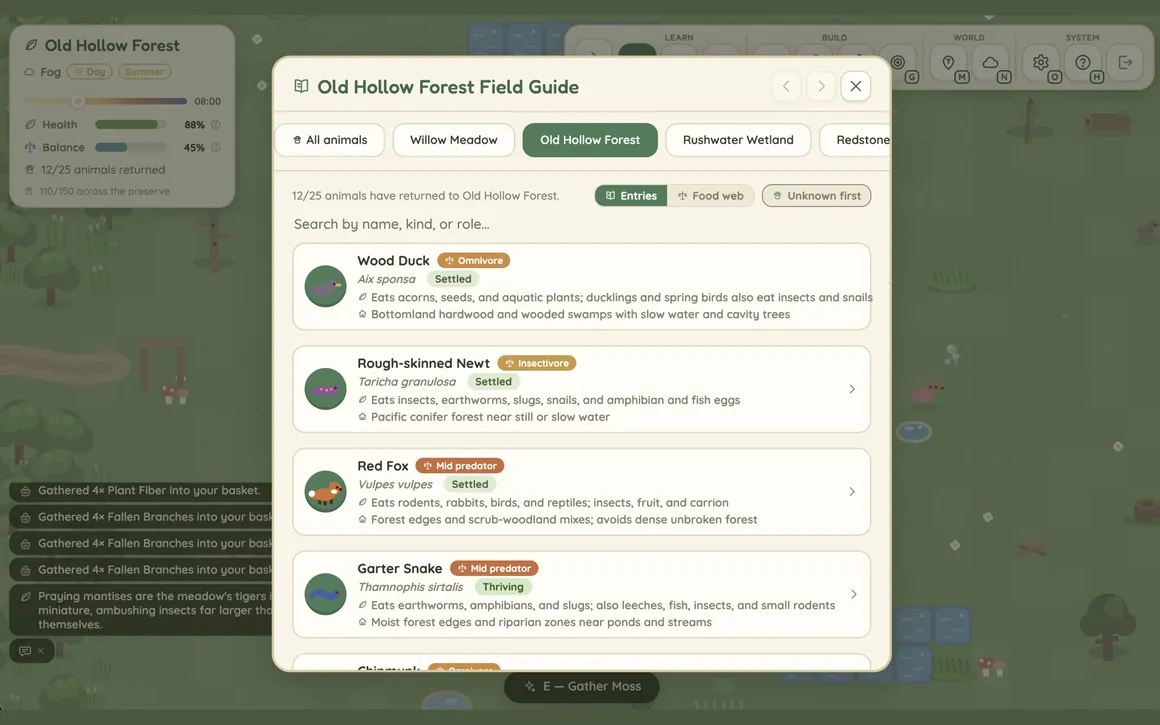
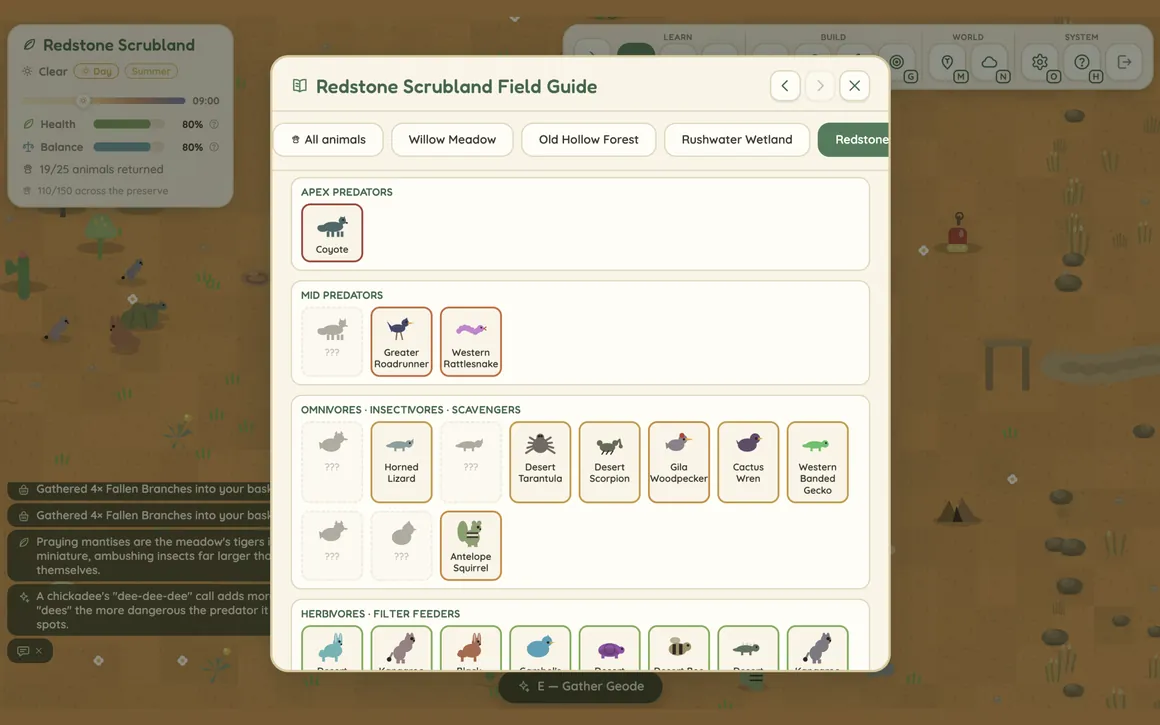
The meadow is the first of six connected areas. Restoring one opens a trail to the next, and animals from every area count toward a single preserve total: 150 species in all, 25 per area, each with real diet, shelter and habitat notes.
If a class gets through the meadow and wants more, the forest is the natural second session: the same mechanic with a vertical structure, so students have to think about the canopy as well as the ground.
Practical details for schools
The section to forward to whoever approves software on your machines.
- Platforms
- macOS, Windows and Linux for the full game, with modest hardware requirements and no graphics card needed. The free demo runs in any reasonably current browser, which usually includes school Chromebooks and managed laptops.
- Internet
- Not required to play the installed game: it runs entirely offline and saves locally to the machine. When the machine is online, the game sends the developer a gameplay snapshot — see what this collects. The browser demo needs a connection throughout.
- Accounts
- No account, no email, no sign-in and no roster upload. A save is just a name the student picks.
- Languages
- Full English and Español — interface, animal notes and field journal alike. Switchable any time from the title screen or Settings › Language.
- Accessibility
- Reduce motion; three colorblind modes including monochrome; four text sizes; five font choices; fully rebindable keys; separate music and effects volume; light and dark mode; and a Simpler wording setting that plainly rewords the whole game, animal notes included. All in one Settings screen, all changeable mid-game.
- Content rating
- Apple 9+. No combat, no failure state, nothing dies. Nothing is hunted, harmed, captured or kept.
- Ads & purchases
- None. No advertising, no in-app purchases, no loot boxes, no chat, and no user-generated content from other players.
- Student data
- Gameplay counters, the settings in use, and the caretaker name typed on the save. No accounts, no email, no cookies used for tracking, no third-party analytics, no advertising identifiers, no location. Nothing a student writes on a worksheet, and no part of their world file, ever leaves the machine. The full list is below.
- Cost
- The demo, the guide and the worksheets are free. Free classroom copies of the full game are available for the asking, below.
What this collects
Stated plainly, because a page that says “nothing” and a privacy policy that says otherwise is worse than either one on its own.
The game plays offline. It reports while online.
The installed game needs no connection to run: its data is bundled with the app, the save is a file on the machine, and a machine that never goes online plays the whole lesson and sends nothing. That is the offline claim, and it is the only one.
When the machine is online, the game sends the developer one snapshot of that save roughly every three minutes, and once more when the window is closed. It contains:
- Gameplay counters — play time, sessions, resources collected, items crafted, plants planted, animals returned, biomes unlocked, achievements earned.
- The machine — app version, platform, operating system family, and the interface language.
- The settings in use — audio and accessibility choices, which is how we know whether the accessibility work is worth continuing.
- A random save ID, generated on the machine and tied to nothing else.
- The caretaker name the student typed when they made the save.
That last one is the field worth your attention, and the reason this section is not a one-liner: it is free text, so a student who types their own name has sent their own name. Tell the class to use the dice button beside the name field, or a nature name. The name cannot be changed afterward, but any snapshot can be deleted on request: email [email protected] with the caretaker name on it.
What is never sent
No accounts, no email addresses, no sign-in, no roster. No cookies used for tracking, no third-party analytics, no advertising identifiers, no location data. No world file, no journal, and nothing a student writes on a worksheet. Nothing goes anywhere except the developer's own server, over HTTPS, and none of it is sold, shared or combined with anything else.
The privacy policy lists every field verbatim and has a section addressed to schools and districts.
Questions teachers ask first
Do I have to buy anything to run the lesson?
No. The whole activity runs on the free browser demo at play.wildwillows.app. Willow Meadow is not capped, so a class can restore it, meet the animals and finish every worksheet without spending anything. The guide and worksheets are free as well, and there are free classroom copies of the full game for the asking.
Will students’ work survive to the next class period?
In the demo, not reliably, and it is worth knowing why. A demo save lives on our server, but the demo has no password — the only way back into it is a pointer kept in that browser on that machine. Clear the site data, switch to a different Chromebook, or hit the demo's time limit, and the save is gone for good. Plan it as a single session and have students carry the evidence out on the worksheets rather than in the save file. The installed full game saves to the machine itself, so a class set of copies is what you want if you would rather run it over several periods.
What if my students cannot install software?
Use the browser demo. It needs nothing installed and no sign-in, so it runs on locked-down school machines and Chromebooks — anywhere with a reasonably current browser. The full game is a download for macOS, Windows and Linux.
Is it appropriate for my grade level?
The lesson is written for grades 5–8, and the game is rated 9+. Younger classes can play it happily: turn on Settings › Simpler wording and lean on Worksheets 1–3. Older students tend to get the most out of Worksheet 6, which asks them to pick apart the model itself.
How much prep does it actually take?
Fifteen minutes. Open the meadow once yourself, print Worksheets 1–3, and check the settings on one machine. The full prep list is above.
Is there anything violent, scary or upsetting?
No. There is no combat, no enemies, and no way to fail. Animals are observed and welcomed home, never hunted, captured or lost, and nothing ever dies. Predators arrive as residents of a recovered food web rather than as a threat.
Can I photocopy the worksheets, or adapt the guide?
Yes. Print, photocopy and share them with your students and colleagues freely. If you rework the lesson into something better, I would love to see it: [email protected].
Can I get help planning it around my curriculum?
Yes, and I would enjoy it. Write with your framework or unit and I will tell you honestly where Wild Willows fits and where it does not.
Free copies for your classroom
A limited number of promo codes are set aside for teachers: full copies of the game, no cost, no expiry, no paperwork. Write from your school address with your school, your grade level, roughly how many machines you would put it on, and a line about why you want to use it with your class. I answer every email either way.